
Homophones List
Homophones are words that sound the same but have different meanings and often different spellings — and they cause some of the most common writing mistakes. This list collects the sets learners meet most, with a short meaning for each word, organised by level so you can teach or practise a few at a time.
- Instant download
- Editable Word
- Print-ready PDF
- 7-day refund
5 files · PDF, DOCX
Homophones Printable Pack
Printable homophone lists in three levels with meanings, choose-the-word worksheets with answer keys, sentence-writing pages, cut-out flash cards and a commonly confused words poster.
- Homophones list (PDF/DOCX)
- Worksheet (PDF/DOCX)
- Sentence practice (PDF/DOCX)
- + 2 more
$5.00 USD, one-time 5 files · about $1.00 each
- Instant download
- 7-day refund
- Secure checkout by Stripe
7-day money-back guarantee. Full refund within 7 days of purchase, even after you download.
Free sample: Homophones List by Level (PDF, 66 KB)
Homophones Printable Pack
Printable homophone lists in three levels with meanings, choose-the-word worksheets with answer keys, sentence-writing pages, cut-out flash cards and a commonly confused words poster.
- Homophones list (PDF/DOCX)
- Worksheet (PDF/DOCX)
- Sentence practice (PDF/DOCX)
- Flash cards (PDF)
- Poster (PDF)
Formats: PDF, DOCX. Instant download after payment (link valid 72 hours, up to 5 downloads). AI-assisted: the templates were drafted with AI help and reviewed and laid out before publishing.
$5.00 USD, one-time 5 files · about $1.00 each
- Instant download
- 7-day refund
- Secure checkout by Stripe
7-day money-back guarantee. Full refund within 7 days of purchase, even after you download.
Free sample: Homophones List by Level (PDF, 66 KB)
Full refund within 7 days — see the refund policy and license.
Free printables
Single sheets you can print right now, no sign-up. The full pack adds every sheet in one download plus the editable files.
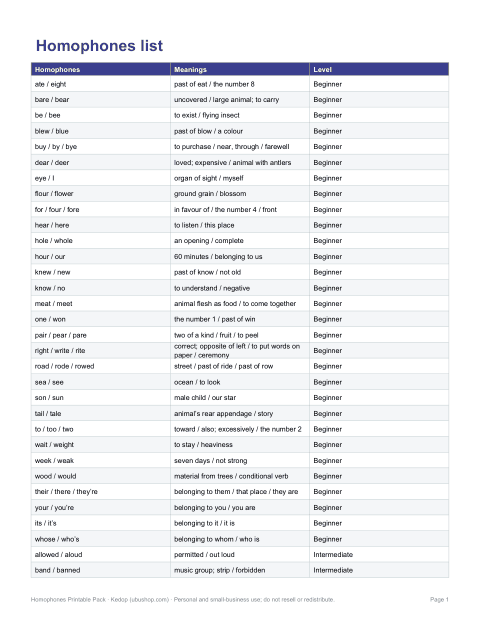
 Printable Homophones List
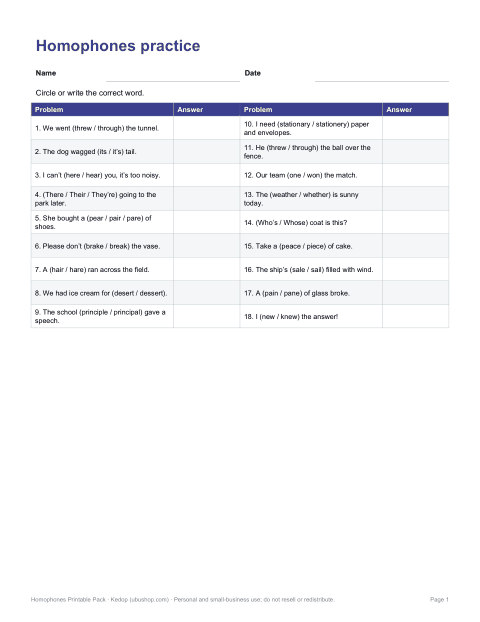
 Printable Homophones Practice Worksheet
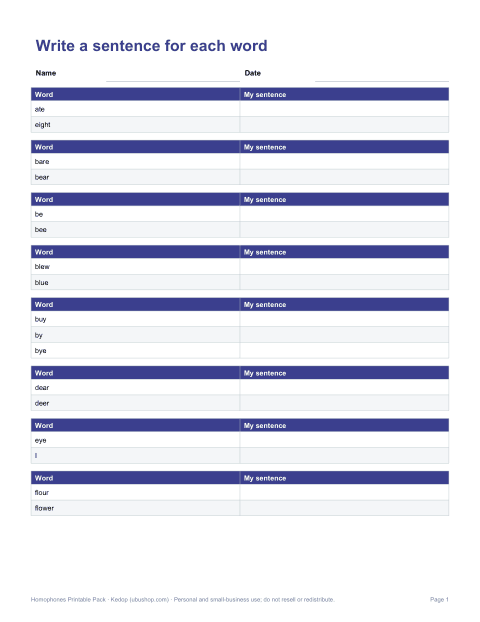
 Homophones Sentence Practice Sheet
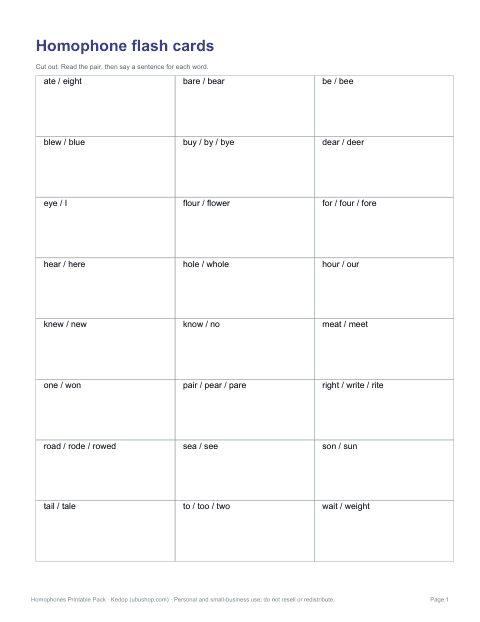
 Homophone Flash Cards Printable PDF
 Printable Homophones Poster Chart
Use the homophones list
Quick quiz: choose the right word
What’s in the pack
- Printable homophones list in three levels (beginner, intermediate, advanced) with meanings
- Worksheets: choose the correct homophone in context, with answer keys
- Write-your-own-sentence practice pages
- Homophone flash cards to cut out
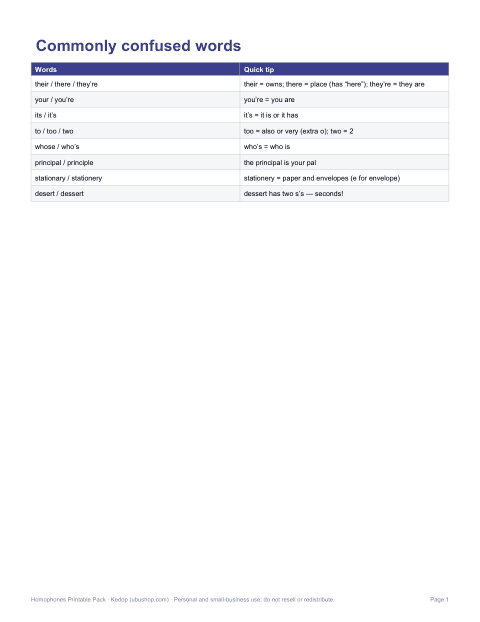
- A “commonly confused words” poster for classrooms
All printables fit US Letter and A4. The searchable list and quiz on this page are free.
What is a homophone?
A homophone is a word that sounds the same as another word but differs in meaning, and usually in spelling — like “flour” and “flower”. Homophones are one kind of homonym. Words that are spelled the same but pronounced differently, like “lead” (to guide) and “lead” (the metal), are called heteronyms or heterophones instead. Because pronunciation varies by accent, a pair that sounds identical in one region may not in another: for many speakers “merry”, “marry” and “Mary” sound alike, while for others they don’t.
Beginner homophones
| Homophones | Meanings |
|---|---|
| ate / eight | past of eat / the number 8 |
| bare / bear | uncovered / large animal; to carry |
| be / bee | to exist / flying insect |
| blew / blue | past of blow / a colour |
| buy / by / bye | to purchase / near, through / farewell |
| dear / deer | loved; expensive / animal with antlers |
| eye / I | organ of sight / myself |
| flour / flower | ground grain / blossom |
| for / four / fore | in favour of / the number 4 / front |
| hear / here | to listen / this place |
| hole / whole | an opening / complete |
| hour / our | 60 minutes / belonging to us |
| knew / new | past of know / not old |
| know / no | to understand / negative |
| meat / meet | animal flesh as food / to come together |
| one / won | the number 1 / past of win |
| pair / pear / pare | two of a kind / fruit / to peel |
| right / write / rite | correct; opposite of left / to put words on paper / ceremony |
| road / rode / rowed | street / past of ride / past of row |
| sea / see | ocean / to look |
| son / sun | male child / our star |
| tail / tale | animal’s rear appendage / story |
| to / too / two | toward / also; excessively / the number 2 |
| wait / weight | to stay / heaviness |
| week / weak | seven days / not strong |
| wood / would | material from trees / conditional verb |
| their / there / they’re | belonging to them / that place / they are |
| your / you’re | belonging to you / you are |
| its / it’s | belonging to it / it is |
| whose / who’s | belonging to whom / who is |
Intermediate homophones
| Homophones | Meanings |
|---|---|
| allowed / aloud | permitted / out loud |
| band / banned | music group; strip / forbidden |
| brake / break | device to stop / to shatter; a rest |
| ceiling / sealing | top of a room / closing tightly |
| cell / sell | small room; unit of life / to exchange for money |
| cent / scent / sent | coin / smell / past of send |
| cereal / serial | grain food / in a series |
| chews / choose | bites repeatedly / to pick |
| creak / creek | squeaking sound / small stream |
| days / daze | plural of day / stunned state |
| dew / do / due | morning moisture / to perform / owed; expected |
| die / dye | to stop living / to colour |
| fair / fare | just; a festival / price of a journey |
| feat / feet | achievement / plural of foot |
| find / fined | to discover / charged a penalty |
| flea / flee | tiny jumping insect / to run away |
| flu / flew / flue | influenza / past of fly / chimney duct |
| grate / great | metal frame; to shred / very large; excellent |
| groan / grown | moan / past participle of grow |
| guessed / guest | past of guess / visitor |
| hair / hare | strands on the head / animal like a rabbit |
| heal / heel / he’ll | to cure / back of the foot / he will |
| higher / hire | more high / to employ |
| hoarse / horse | rough-voiced / riding animal |
| knight / night | armoured warrior / time of darkness |
| knot / not | tied loop / negative |
| lead / led | heavy metal (LED) / past of lead |
| made / maid | past of make / household worker |
| mail / male | letters / masculine |
| main / mane | most important / neck hair of a horse or lion |
| missed / mist | failed to hit; longed for / fine spray |
| moose / mousse | large deer / light dessert |
| none / nun | not any / member of a religious order |
| pail / pale | bucket / light in colour |
| pain / pane | hurt / sheet of glass |
| passed / past | went by / earlier time |
| peace / piece | calm / a part |
| plain / plane | simple; flat land / aircraft; flat surface |
| rain / reign / rein | water from clouds / rule of a monarch / strap to guide a horse |
| read / red | past of read / a colour |
| real / reel | genuine / spool |
| sail / sale | fabric that catches wind / selling |
| scene / seen | view; setting / past participle of see |
| sew / so / sow | to stitch / therefore / to plant seeds |
| stair / stare | step / to look fixedly |
| stake / steak | post; share / cut of beef |
| steal / steel | to take illegally / strong metal |
| threw / through | past of throw / from one side to the other |
| toe / tow | digit on the foot / to pull |
| waist / waste | middle of the body / to squander; rubbish |
| way / weigh | path; method / to measure weight |
| weather / whether | atmospheric conditions / if |
| which / witch | what one / woman said to practise magic |
| whine / wine | complaining sound / drink from grapes |
Advanced homophones
| Homophones | Meanings |
|---|---|
| aisle / isle / I’ll | passage between seats / island / I will |
| altar / alter | table in a church / to change |
| bolder / boulder | braver / large rock |
| bough / bow | tree branch / to bend forward |
| capital / capitol | main city; money / legislative building |
| cite / sight / site | to quote / vision / location |
| coarse / course | rough / path; class |
| complement / compliment | completes / praise |
| council / counsel | governing group / advice; to advise |
| discreet / discrete | tactful / separate |
| elicit / illicit | to draw out / illegal |
| foul / fowl | offensive; rule-break / bird |
| gorilla / guerrilla | great ape / irregular fighter |
| idle / idol | inactive / object of worship |
| lessen / lesson | to reduce / something taught |
| loan / lone | money lent / single |
| muscle / mussel | body tissue / shellfish |
| naval / navel | of the navy / belly button |
| palate / palette / pallet | roof of the mouth / artist’s board / platform for goods |
| pedal / peddle | foot lever / to sell |
| principal / principle | head of a school; main / basic truth |
| profit / prophet | gain / one who predicts |
| stationary / stationery | not moving / writing materials |
| suite / sweet | set of rooms / sugary |
| vain / vane / vein | proud; futile / weather indicator / blood vessel |
| wade / weighed | to walk through water / past of weigh |
| yoke / yolk | wooden frame for oxen / yellow of an egg |
Worked example: teaching their / there / they’re
A second-grade teacher introduces one set a week. On Monday the class sorts sentence strips into three piles — “Their dog is big”, “Put it over there”, “They’re my friends” — and learns a clue for each: “there” contains “here” (a place), “their” contains “heir” (someone who owns something), and “they’re” has an apostrophe because a letter is missing from “they are”. Midweek they do the worksheet from the pack, and on Friday they write their own three sentences. The next week the class moves on to to / too / two.
Tips for learning homophones
- Learn one set at a time, in sentences rather than in isolation.
- Use memory clues: “dessert” has two s’s because you want seconds.
- Contractions (it’s, you’re, they’re, who’s) can always be expanded — if “it is” doesn’t fit, use “its”.
- Read your writing aloud slowly; spell-checkers usually miss homophone errors.
- Draw pictures for pairs like flour / flower and hare / hair.
AI-assisted content
This list and the worksheets were drafted with AI assistance and reviewed before publishing. Homophones depend on accent; a few pairs may not sound identical where you live.
Frequently asked questions
What are homophones?
Words that sound the same but have different meanings, like hear and here.
What are the most common homophones?
To/too/two, their/there/they’re, your/you’re and its/it’s.
What is the difference between homophones and homonyms?
Homophones sound alike; homonyms can mean words that sound or are spelled alike.
At what age do children learn homophones?
Simple sets are often taught in the early grades, with harder pairs through upper elementary and middle school.
Can I print the list?
Yes — the template pack has printable lists, worksheets and flash cards.
Is this a subscription?
No, it is a one-time download.